Kismet - Dice Game
- 4.9
- Rating
- 100.00K
- Installs
- Free
- Price

 Analysis by App-foxy
I spent time with Kismet as a colorful board game built around dice, and my first impression was that it aims for a lighter, more approachable kind of tabletop session rather than a long, rules-heavy strategy match. That distinction matters. If you want something you can open casually, understand without studying a manual, and share with people who may not normally play board games on mobile, this is an appealing starting point. If you are looking for a deep competitive system with a large amount of strategic control, you should approach it with more caution.
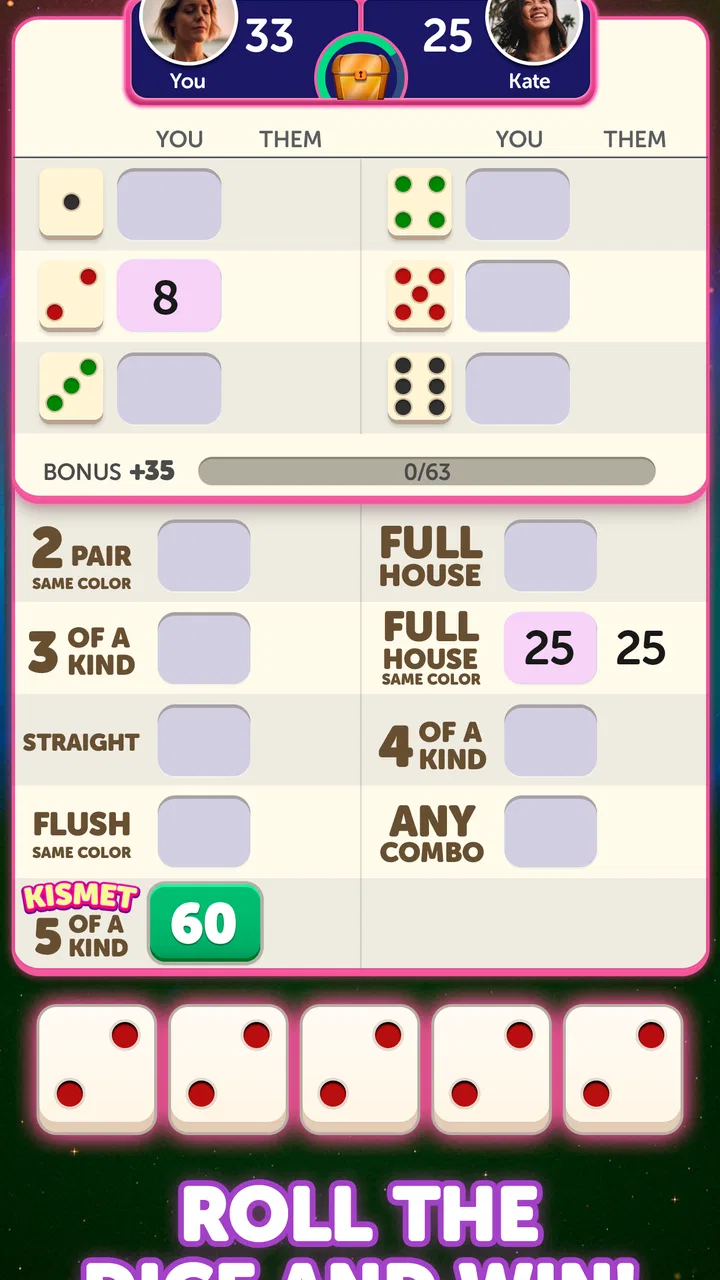
The game comes from FunCraft Games and is available as a free download for players on Android devices using version 7.0 or later. It is rated for Everyone, which makes its presentation suitable for a broad audience. The central idea is simple to recognize from the name and store summary: dice are the focus, but the presentation gives the familiar format a more colorful twist. In my experience, that combination makes the game feel less intimidating than many traditional board-game adaptations.
How the dice-focused board game feels in everyday use
The most useful way to think about Kismet is as a casual board-game option for short breaks, relaxed evenings, or shared play when nobody wants to learn a complicated rule set first. Dice naturally create a mixture of choice and luck. You can make sensible decisions, but you cannot control every result, so the mood stays lighter than in a purely tactical game.
You May Also Like

 Blood Strike: 2.5 Anniversary
Blood Strike’s Loadouts Turn Every Drop Into a Tactical Gamble
A close look at Blood Strike’s custom loadouts: how fast access to signature weapons reshapes its battle royale rhythm, rewards preparation, and narrows the gap between fights.

 Pandora - Music & Podcasts
Pandora’s Music Is Easy to Start, but Harder to Recover
Pandora’s strength is its low-effort path from a seed to a station. Its weak spot is how much confidence it asks you to place in connection, setup, and quiet recovery.

 8 Ball Pool
 Is Built on Rivalries, Rematches, and Routine
A close look at the rivalries, rematches, shared routines, and unanswered safety questions that turn a quick pool match into a persistent mobile community.

 Samsung Music
’s Quiet Strength Is Playing What You Already Own
Its reach comes less from spectacle than from dependable access to a personal library. That simplicity is both the app’s strongest retention engine and its ceiling.

 AccuWeather: Weather Radar
AccuWeather Review: A Quick, Clear Forecast for Everyday Decisions
For everyday plans, the best forecast is the one you can understand quickly. AccuWeather makes rain timing, radar, and local conditions easy to act on, with a few trade-offs.

 Hill Climb Racing
Why Hill Climb Racing Still Turns Crashes Into One More Run
A tiny car, a bumpy hill and one more upgrade: Hill Climb Racing keeps resurfacing because its simple chaos makes every near-miss feel personal.
More From Our News Desk



That balance is also the game’s main personality. A dice game can be welcoming because every turn gives you an immediate event to react to. You are not expected to memorize a large collection of cards, manage a complicated inventory, or understand a long chain of interactions before making your first useful move. The colorful style supports that accessibility, giving the experience a friendlier tone than a serious-looking strategy board.
I would describe the presentation as best suited to players who enjoy simple board-game rhythms: take a turn, read the result, consider the next opportunity, and keep going. That structure works well when you want entertainment without a major time commitment. It is also a good fit for younger players and families because the age rating is Everyone, although adults who prefer thoughtful planning should remember that dice-based play always includes an element of unpredictability.
What the free download means for value
The most important cost detail is straightforward: Kismet is free to download. That gives you a low-risk way to test the game instead of committing money before knowing whether its dice-driven style suits you. For a casual board title, that is a meaningful advantage. You can try a few sessions, see whether the pace feels comfortable, and decide whether it deserves a place on your device.
The game also includes in-app purchases ranging from $0.49 to $49.99 per item. I would treat that range as a reason to make your own spending limit before buying anything. Free access and paid value are not the same thing. The download lets you explore the experience without an upfront charge, but the presence of optional purchases means the overall value depends on how much of the game you enjoy without spending and whether any paid items feel worthwhile to you.
I do not see a reason to describe the most expensive purchase as necessary for enjoying a dice game. A casual player should begin with the free experience and only consider a purchase after identifying a specific benefit that improves the way they play. That approach is more sensible than paying simply because an item is available. For children, I would also recommend checking purchase settings before handing over the device, even though the game itself carries an Everyone rating.
This is where Kismet differs from a paid board-game app. With a one-time purchase, you usually know the cost of entry and can judge the whole package against that price. Here, the initial barrier is lower, but the value question moves inside the game. Players who dislike in-app purchases may prefer a traditional paid alternative, while players who want to sample a game before spending anything will probably appreciate the free starting point.
Where the colorful presentation helps
The visual direction is not just a cosmetic detail. Dice games can become visually repetitive when every turn looks like a plain roll followed by a number. A more colorful presentation helps keep the board readable and gives the experience a warmer identity. For me, that makes Kismet easier to recommend in social situations, especially when one person is introducing the game to someone who is unsure about mobile board games.
Color can also help separate the game from dry digital versions of familiar tabletop formats. The important trade-off is that visual charm cannot replace meaningful decisions. If you mainly judge a board game by the depth of its planning, the bright style will not be enough on its own. I found the presentation most valuable as an invitation to play, not as proof that the underlying system will satisfy expert strategists.
A practical tip is to use the first sessions as a learning period rather than trying to optimize every roll immediately. In a dice-focused game, players often waste energy becoming frustrated by unlucky outcomes. Instead, pay attention to which choices repeatedly create useful results and which decisions only feel attractive because they offer a dramatic short-term possibility. That habit lets you separate genuine strategy from wishful thinking, which is especially helpful when luck is part of the design.
Why the dice create both fun and friction
The appeal of dice is their uncertainty. A good result can change the mood of a session instantly, and an unexpected outcome can give a less experienced player a chance to stay competitive. That makes the game more welcoming than a system where the strongest planner always wins. It also means that a careful decision may fail for reasons outside your control.
That trade-off is important for deciding whether Kismet is right for you. I would recommend it to players who enjoy reacting to changing situations and do not need every victory to feel fully earned through planning. I would not put it first for someone who becomes annoyed when a strong position disappears because of an unlucky roll. In that case, a more deterministic board game, puzzle game, or turn-based strategy title may offer a better sense of control.
Another useful way to play is to judge success by the quality of your decisions rather than by the final result of one session. If you choose a sensible line and the dice go against you, that does not automatically mean the choice was bad. Conversely, a lucky outcome does not prove that a risky move was smart. This mindset makes the experience more enjoyable and prevents the random element from dominating your opinion of the whole game.
A realistic use case for casual players
Imagine a family waiting for dinner or a group of friends looking for something to do during a short break. One person can install the free game, explain the basic idea, and start a session without preparing a table full of pieces. The colorful design makes it easier to invite a hesitant player, while the dice give everyone an immediate reason to pay attention to the next turn.
It can also work as a low-pressure evening game for two people who want interaction without a long campaign. You can play with a relaxed attitude, discuss whether a risky choice was worth taking, and enjoy the changing results. The important word is “casual.” I would not choose it for a planned board-game night where the group expects detailed rules, extensive player powers, or a long strategic arc.
For younger players, the Everyone rating is reassuring, but I would still play alongside them at first. The goal would not be to supervise the content so much as to help them understand the relationship between a decision and a dice result. That also gives parents a chance to control any purchase decisions and decide whether the game’s pace suits the child.
How it compares with familiar alternatives
Compared with a physical dice game, Kismet is more convenient because there is no need to find pieces, set up a table, or keep track of components. The phone handles the presentation, and the game is ready whenever you have a spare moment. The compromise is that a digital version cannot reproduce the same tactile feeling as rolling real dice or moving pieces across a shared table.
Compared with a classic board-game app, Kismet appears aimed more at immediate accessibility than at recreating a large, established tabletop system. That is useful for newcomers but may feel limited to experienced players who want a large rules ecosystem. A traditional board-game adaptation is often better when you already love a particular physical game and want its full structure on mobile.
Compared with puzzle games, Kismet offers less certainty and more social unpredictability. A puzzle usually rewards careful analysis with a clearer path toward the solution. Here, the dice can interrupt your plans, which creates excitement but reduces precision. Compared with competitive strategy games, it should be easier to enter but less satisfying for players who want every outcome to reflect long-term mastery.
My advice is to choose based on the kind of control you enjoy. Pick Kismet when you want colorful, dice-centered decisions with luck in the mix. Choose a puzzle or deterministic strategy game when you want to solve a problem with minimal randomness. Choose a paid board-game adaptation when you prefer a known, complete ruleset and a clearer relationship between price and content.
Practical expectations before installing
The game is free, but I would not install it expecting a completely cost-free experience if you are the kind of player who feels pressure to unlock every available option. The in-app purchase range makes it especially important to decide what “enough” means for you. If the free play already provides the relaxed dice experience you wanted, stop there. Spending should be a choice, not a requirement created by comparison with other players.
It is also worth checking whether your device meets the operating-system requirement before trying to install. Kismet supports Android 7.0 and later, so users with much older devices should not assume compatibility. On supported hardware, the current version is 1.2.25077, which is useful to know when checking that the installed copy is up to date.
The game has reached over fifty thousand installs and holds a 4.8 average from around three thousand six hundred ratings, alongside three hundred fifteen written reviews. Those figures suggest that the early audience has responded positively, but I would still treat them as a starting signal rather than a substitute for your own trial. Ratings can tell you that the concept is connecting with players; they cannot tell you whether your personal tolerance for randomness matches the game.
Who will get the most from it
I think Kismet offers the strongest value to casual board-game fans, families, newcomers, and players who enjoy a colorful presentation without needing a large commitment. It is particularly attractive if you want to try a dice game before paying for anything. The free entry point lets you make that decision through experience rather than guesswork.
It may also suit someone who wants a social icebreaker. A dice-based game gives people something concrete to discuss, and the random results can keep a session from becoming too predictable. If your group includes players with different skill levels, the luck element may help prevent the most experienced person from dominating every turn.
I would be more hesitant to recommend it to competitive players who dislike randomness, collectors who want a complete premium package from the start, or fans of complex board games with deep asymmetry and long-term planning. Those players may find the accessible format too light, especially after the novelty of the colorful dice presentation fades.
My verdict on whether to try it
After reviewing it as a free board game, I see Kismet as an easy recommendation for testing rather than an automatic recommendation for everyone. The lack of an upfront price is its clearest value advantage, and the Everyone rating broadens its appeal. FunCraft Games has chosen a familiar foundation and given it a brighter, more approachable identity, which makes the game suitable for short, relaxed sessions.
The main caution is the same feature that creates much of the fun: dice introduce luck. You need to enjoy making decisions without controlling the final outcome every time. I would also keep a close eye on in-app purchases, especially if children use the device or if you tend to chase every optional item in a free game.
My recommendation is to try the free version first and judge it by your reaction to the randomness. If you enjoy the quick decisions, colorful board style, and casual competition, it can be a pleasant addition to your mobile game collection. If you want exact control, a fixed one-time purchase, or a deeper strategy system, I would skip it in favor of a deterministic puzzle, a premium board-game adaptation, or a more substantial strategy title.
In short, Kismet works best when you treat it as an approachable dice game for everyday play, not as a replacement for every kind of board game. Its strongest quality is the low-risk invitation to sit down and roll. Its biggest limitation is that the same randomness may frustrate players who want their planning to decide everything.
FAQs for Kismet - Dice Game
01What is Kismet - Dice Game and how is it played?
Kismet - Dice Game is a strategic dice game that combines elements of chance and skill. Players roll five dice up to three times per turn to create scoring combinations similar to Yahtzee. The objective is to accumulate the highest score through various combinations such as straights, flushes, and full houses. It's suitable for solo play or multiplayer sessions.
02Is Kismet - Dice Game available for both Android and iOS platforms?
Yes, Kismet - Dice Game is available for both Android and iOS devices. You can find it on the Google Play Store for Android users and the Apple App Store for iOS users. The game is optimized for a wide range of devices, ensuring a smooth and enjoyable gaming experience across platforms.
03Are there in-app purchases in Kismet - Dice Game?
Kismet - Dice Game offers optional in-app purchases. While the core game is free to download and play, these purchases can enhance your gaming experience by unlocking additional themes, dice designs, or removing ads. However, the game is fully enjoyable without spending any money, making purchases purely optional.
04Can I play Kismet - Dice Game offline?
Yes, Kismet - Dice Game can be played offline, making it a great option for on-the-go entertainment without requiring an internet connection. However, some features like multiplayer modes or leaderboards may require connectivity to fully function. Offline play is perfect for uninterrupted solo sessions.
05Is there a multiplayer option in Kismet - Dice Game?
Kismet - Dice Game includes a multiplayer option where you can compete against friends or players worldwide. You can invite friends to join a game or match with random opponents online. This feature adds a competitive edge and enhances the social aspect, making the game more engaging and fun.
Pros
- Engaging multiplayer mode enhances social interaction.
- Visually appealing with intuitive user interface.
- Includes daily challenges to keep users engaged.
- Offers offline mode for uninterrupted play.
- Customizable dice and board themes.
Cons
- In-app purchases can be expensive.
- Occasional connectivity issues in multiplayer.
- Ads can be intrusive during gameplay.
- Limited tutorial for beginners.
- Game updates are infrequent.

Kismet - Dice Game
Gallery